
Mapo Tofu is in my all-time Top 5. That’s how much I love it! So I am beyond excited to bring you this Sichuan classic that is everything a great, authentic Mapo Tofu should be – fiery, deeply savoury, unapologetically bold and so incredibly delicious, I almost wept with happiness!
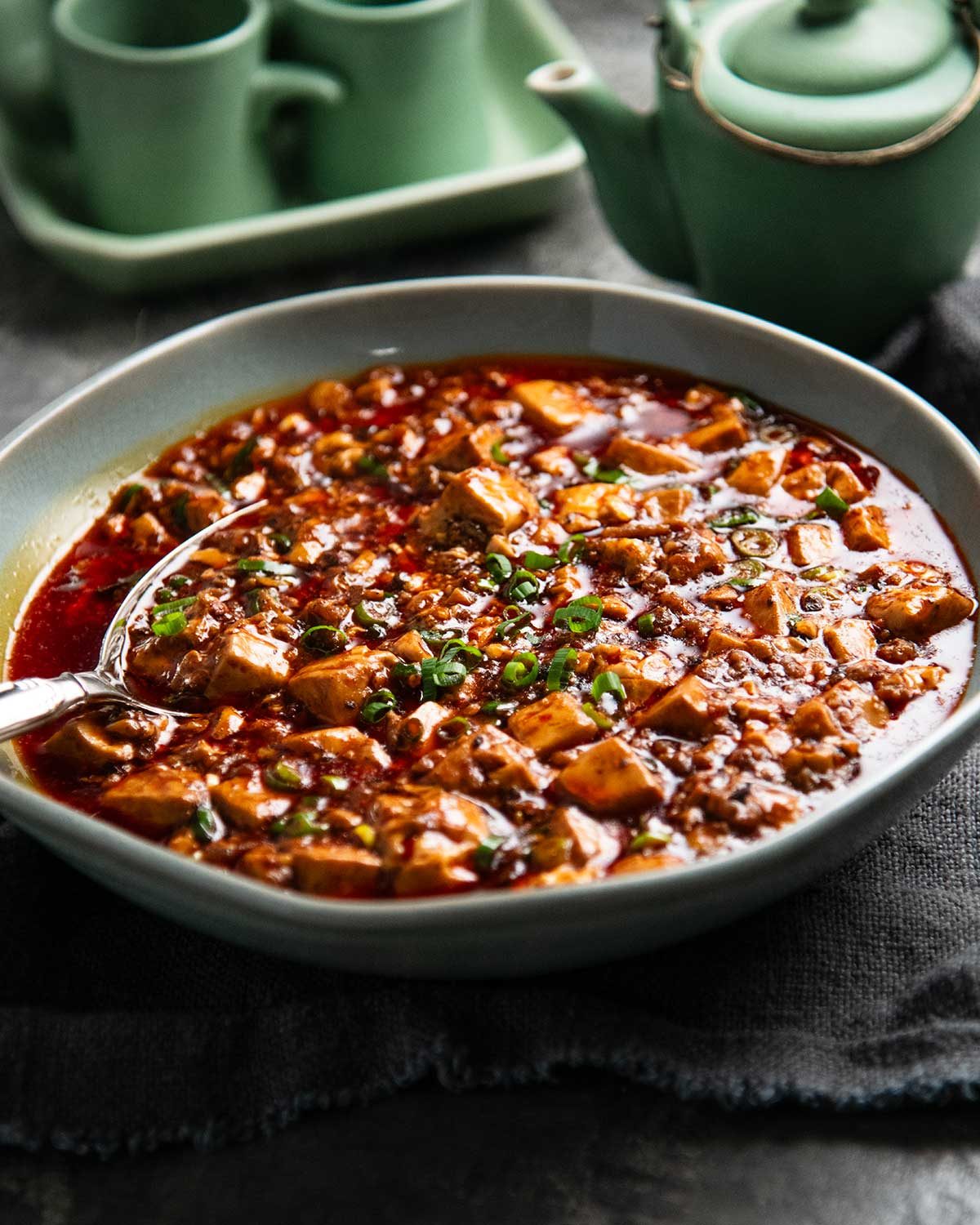
Recipe credit: our very own Chef Hannah!
This is another great recipe by our RTM Chef Xiao (Hannah) Huang, born and raised in Sichuan. So she knows a thing or two about Mapo Tofu! She’s built quite the reputation over the past year with recipes like Beef in Black Bean Sauce and her Chilli Crisp. See all of Hannah’s recipes here.
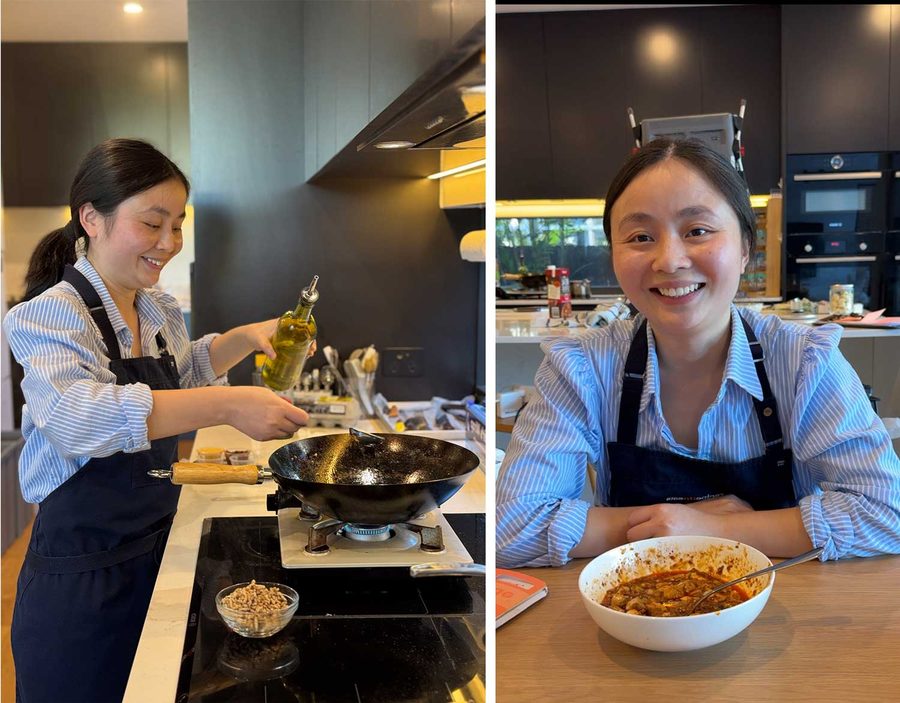
Mapo Tofu
I almost can’t believe this day has arrived! After 20+ years of chasing a Mapo Tofu recipe that truly stacks up to the unforgettable bowls I ate in China, we’re finally here. I’ve ordered it every chance I got in my hometown of Sydney, and I’ve cooked countless recipes at home, always convinced the next one would be the one.
But they all seemed to be missing that little something. Lack of flavour punch. Or complexity of flavour.
So how fortuitous it is that we have Chef Hannah at RecipeTin Meals who comes from a multi-generational family of chefs in Sichuan, the birthplace of Mapo Tofu! And today I’m sharing her recipe for the iconic Mapo Tofu.
My eternal thanks to Chef Xiao (Hannah) Huang – and to the generations of chefs in her family for sharing the secrets to truly great Mapo Tofu with us.
What is Mapo Tofu?
Mapo Tofu is a famous Sichuan dish made with silken tofu gently braised in a fiery, savoury sauce flavoured with chilli bean paste (doubanjiang), Sichuan pepper, minced pork or beef, and aromatics. It’s known for its signature málà flavour – a combination of the tongue-tingling numbing sensation (má) from Sichuan peppercorn and spicy heat from chilli powder (là) – and the soft tofu that melts in your mouth, with layers upon layers of fragrant flavour in the sauce.
It’s one of those dishes that’s impossible to forget once you’ve had a really good one, and perfectly captures everything people love about Sichuan cuisine. For me, as a lover of kapow! flavoured food who is known for regularly wailing, “I need a spicy Asian fix!”, this is about as good as it gets. I am completely and utterly besotted with Mapo Tofu, and I can’t tell you how ridiculously happy I am that I can now make it at home anytime I want. I only waited 20 years for this moment!!!!
Ingredients in Mapo Tofu
Here is what you need to make a truly authentic Mapo Tofu with big, bold Sichuan flavours! There are 3 ingredients that will require a trip to the Asian store that won’t cost much more than $10 in total. Everything else are pantry staples or fresh ingredients from regular grocery stores. The total cost of the ingredients to make this was around A$13, which is far cheaper than eating out – if you can even get Mapo Tofu this good outside of China!
1. MAPO TOFU SPECIALITY INGREDIENTS
These are the 3 ingredients that you’ll need to get from an Asian store. Though if you’ve made my Beef in Black Bean Sauce and Sichuan Eggplant with Minced Pork before, your pantry will already stock them!
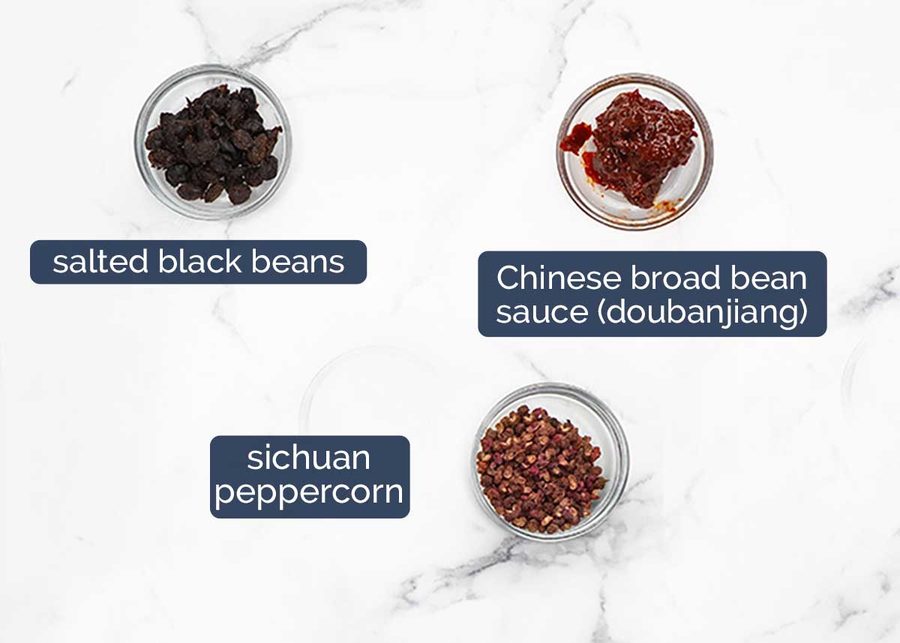
Sichuan peppercorns (pink/red)
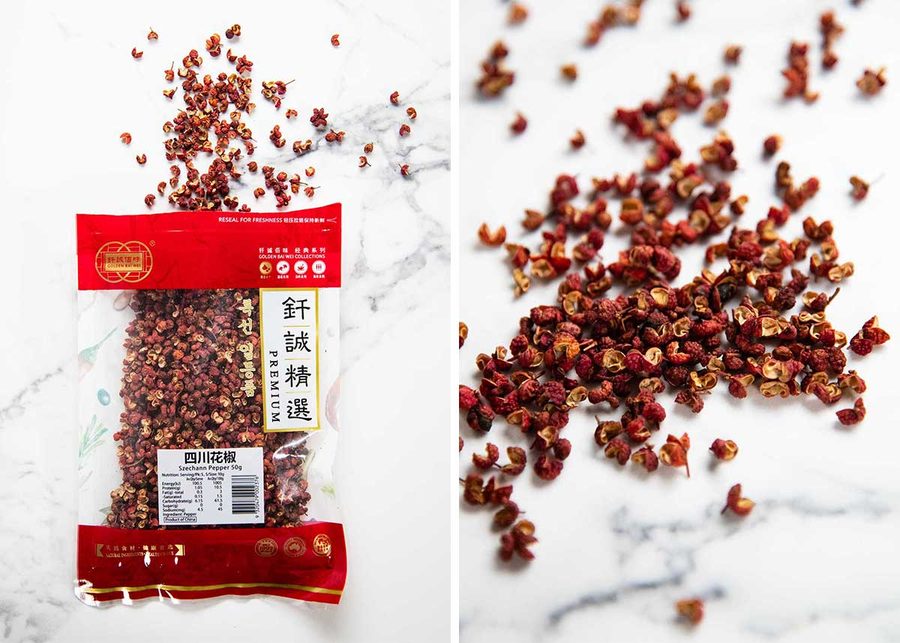
The cool, numbing, almost lemony spiciness of Sichuan pepper is a signature characteristic of mapo tofu! It’s completely different to the hot spiciness of powders like cayenne pepper and chilli powder (below). Use pink / red sichuan peppercorns if you can as this is the traditional choice (slightly warmer and more rounded flavour), else the regular green ones are fine too (it is a little sharper, but honestly I’d use it in a pinch).
Pre-ground Sichuan powder – In some recipes, I say it’s ok to use pre-ground where it is not a primary flavouring of a dish (like Xinjiang Cumin Lamb Stir Fry). But for Mapo Tofu, it’s such a key flavour that I really urge you to grind your own as it is so different, so much fresher than using pre-ground! Find Sichuan peppercorns at Asian grocery stores (~$3 for a large packet). As for a substitute, I can’t think of anything for this recipe.
Preserved black beans (salted black beans)
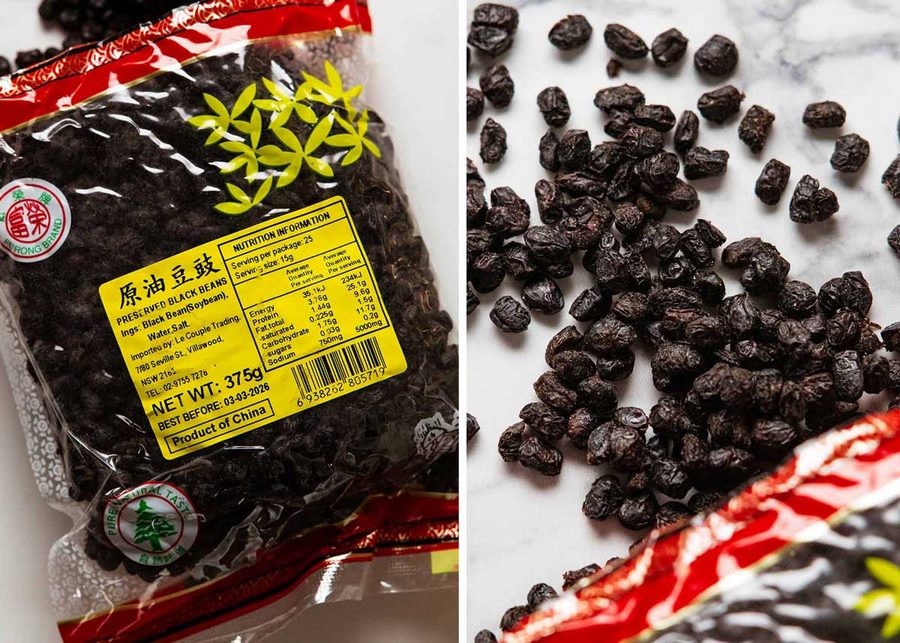
These are actually fermented soy beans, not black beans the legume! It is the same salted black beans used in everybody’s favourite Beef in Black Bean Sauce. Called dòu chǐ in Mandarin or dau6si6 in Cantonese 豆豉 (thank you for the language lesson Woks of Life!), they have a texture like firm raisins and adds savoury saltiness into the sauce.
Find them at Asian grocery stores alongside pickled and vac packed vegetables. They cost around $2.70 for the smallest packs.
No suitable substitute that I can think of. Jarred black bean stir fry sauce doesn’t have nearly the right intensity of flavour.
Chinese broad bean sauce (doubanjiang)
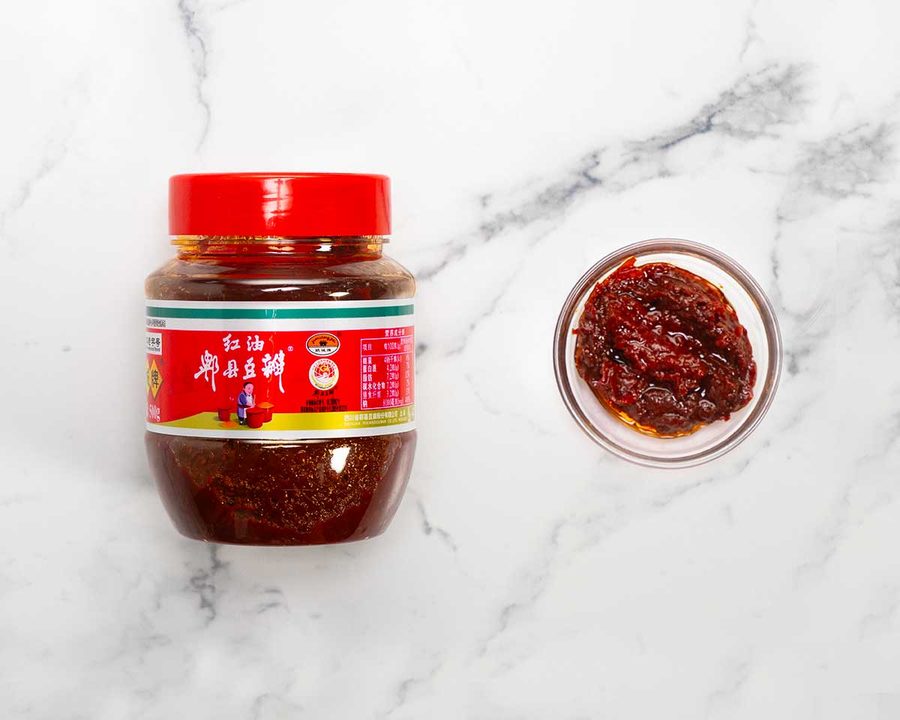
This is a red fermented paste made from broad beans, soybeans, salt, and often chilli. Savoury, salty, and packed with umami! This is another key flavouring in Mapo Tofu sauce. We use the spicy Sichuan version (Pixian doubanjiang) which is a well known brand.
Find it at Asian grocers, it costs ~$3.50 for a 500g/1lb jar, we only use a small amount in this recipe. It’s also used in Spicy Sichuan Pork and Eggplant. Substitute – None that we have tried, sorry!
2. silken tofu
Mapo tofu is a tofu dish, not a meat dish. Think of it as braised tofu with a bit of meat. So using the right type of tofu makes all the difference!
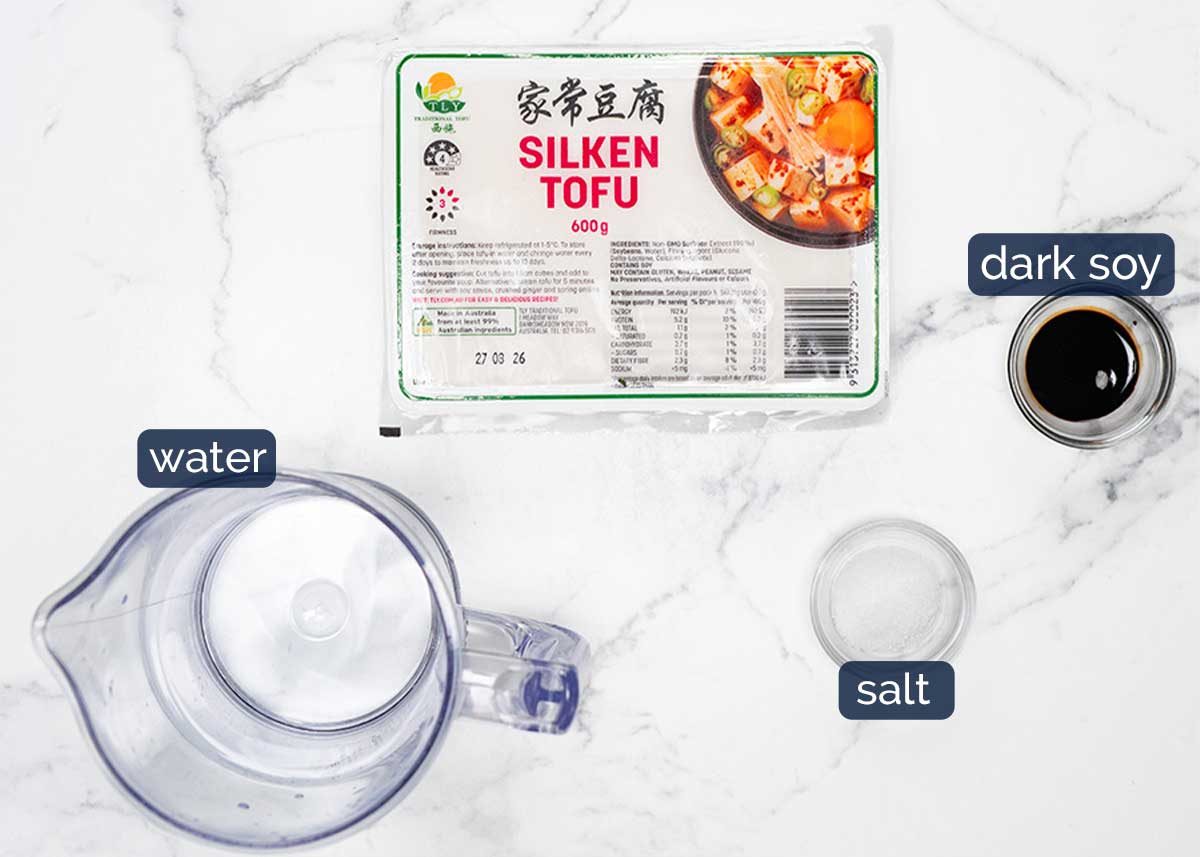
Silken tofu – The soft, delicate, jiggly silken tofu is a key ingredient in mapo tofu. Find it in tubs labeled “silken tofu” or “silk tofu”, in the refrigerator section.
Salt – Tofu is, speaking frankly, bland! So getting salt in inside the tofu by blanching it before stir frying is a key step.
Dark soy sauce – This stains the tofu a light brown colour, lightly seasons it and adds a touch of flavour. We only use the tiniest amount – just 1/4 teaspoon (dark soy is intense stuff!). Substitute with light or regular soy sauce.
3. mapo tofu sauce ingredients
In addition to Sichuan pepper, broad bean sauce and salted black beans, here are the ingredients that flavour the mapo tofu sauce. Pantry staples!
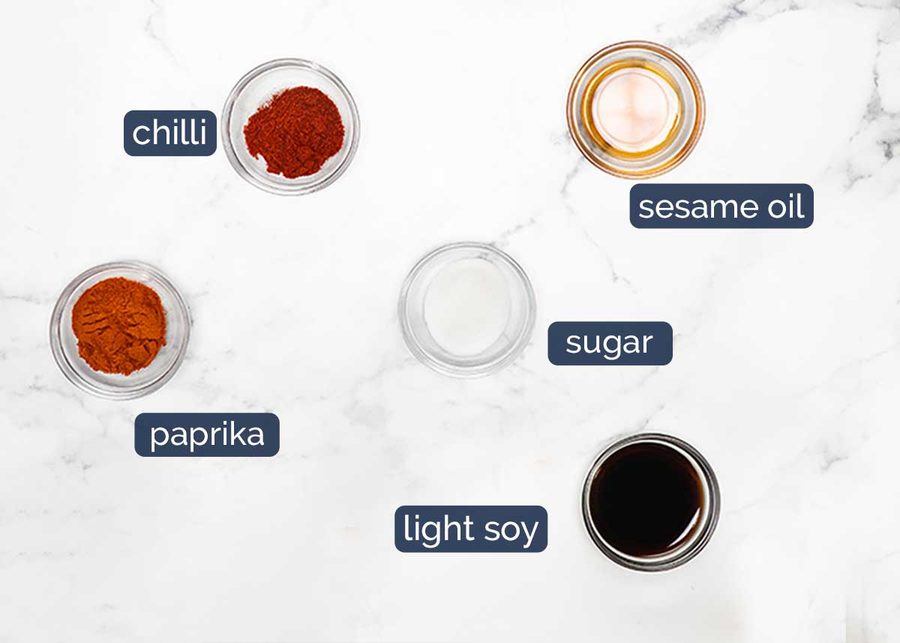
Chilli powder – This brings spiciness into the dish, it is pure plain dried chilli powder. Not to be confused with US Chili Powder with one “l” which is a Tex-Mex spice blend that is not spicy! If you can’t find chilli powder, use cayenne pepper instead but reduce the amount by half (it’s spicier). Chef Hannah specifically made a batch of Mapo Tofu to check this.
Smoked paprika – This helps us achieve the signature red colour. It’s not used in traditional mapo tofu which relies only on chilli powder (see FAQ for information about this). But if you use enough to make the oil red, it makes so spicy, I literally can’t eat it! So in this recipe, we use the amount of chilli powder to achieve our desired level of spiciness, then top up with paprika to get the colour right.
We like using smoked paprika as the hint of background smokey flavour is lovely, but it can be substituted with regular / sweet paprika.
Sesame oil – Use toasted sesame oil (brown) not un-toasted (yellow, less sesame,e flavour).
Light soy sauce – This adds extra salt into the sauce.
White sugar – Just the smallest amount, to balance the sauce.
4. everything else you need
And here’s everything else you need – the meat (pork or beef), braising liquid, aromatics and sauce thickener. You will be surprised how little pork is used – just 100g / 3.5 oz – but it seems like so much more in the finished dish!
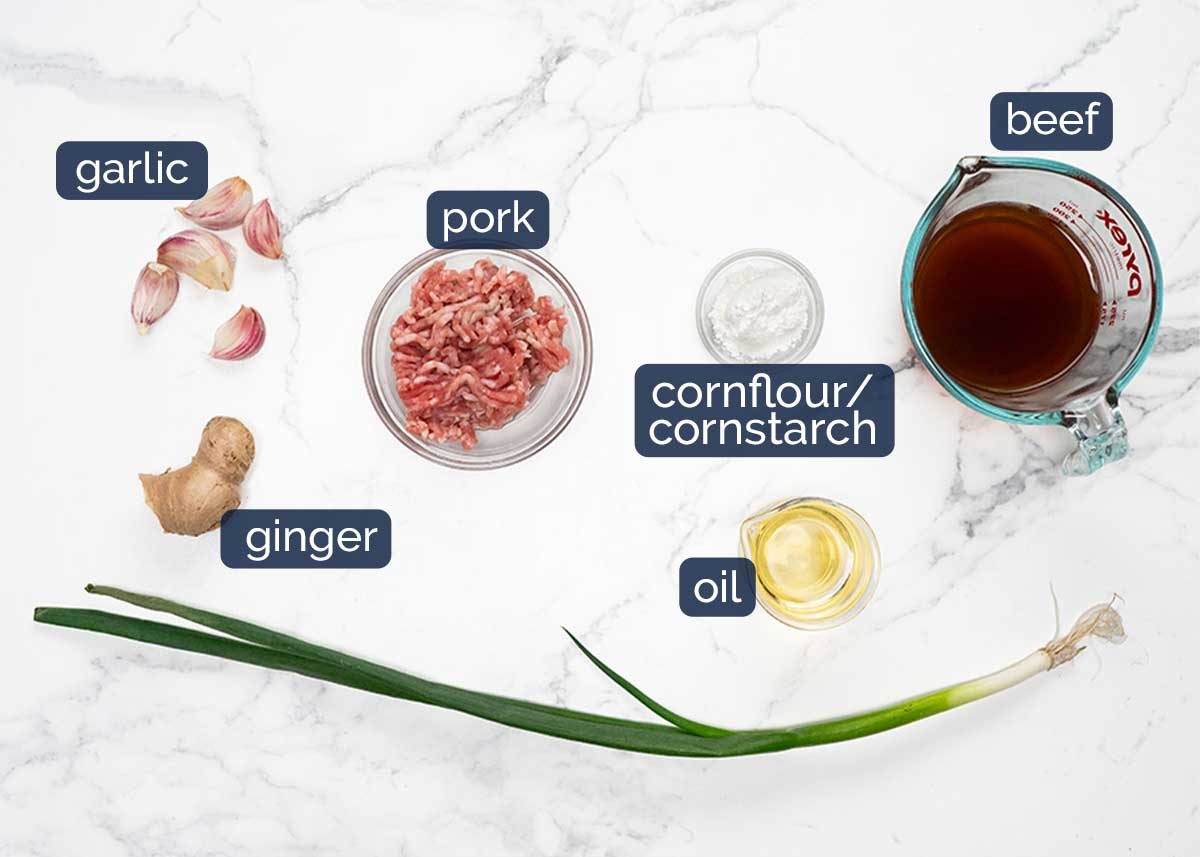
Pork – Use 20% fat pork mince (ground pork) if you can find it. Some grocery stores in Australia (like large Woolworths in Asian areas) sell pork with the fat percentage specified. But I’ve also made it with lean pork mince and while it won’t go quite as golden when cooked, I really couldn’t tell the difference in the finished dish.
Beef alternative – Beef is actually the traditional meat used in Mapo Tofu, but pork is widely used as well. I’ve never seen Mapo Tofu with beef. We made it with both, and I prefer pork because it’s softer so it melds with the tofu better. See FAQ for more information and pork vs beef, and authenticity comments.
Garlic and ginger – A good amount of both! 2 tablespoons of garlic and 2 1/2 tablespoons of ginger. Use a knife to finely mince them, don’t use the garlic crusher or a grater as it makes it wet and pasty so it can’t be sautéed.
Cornflour/ cornstarch – This is what thickens the mapo tofu sauce and makes it nice and shiny.
Oil – Use any neutral flavoured oil suitable for cooking. I use canola oil. Vegetable or peanut oil are also suitable.
The recipe calls for 1/3 cup in total, which I know sounds like a lot! But that glossy layer of red chilli oil floating on the surface is a hallmark of great mapo tofu, so you need this much to achieve it. And despite this amount, the dish does not seem oily or overly heavy. If you decide the cut down, let’s keep it between you and I – don’t tell Chef Hannah! 😅
Authenticity note: Traditional Mapo Tofu is made with Caiziyou oil which is the most common everyday oil used in Sichuan, but difficult to find here in Australia. See FAQ for more comment about this.
Beef stock/broth – This is the liquid used for simmering the mapo tofu. Use low sodium or unsalted. Full salt will make the sauce too salty.
Green onion – This is finely sliced then stirred through, for some freshness.
How to make Mapo Tofu
Once you’ve gathered, chopped and measured out the ingredients, the cooking part is straightforward and takes around 30 minutes, most of which is simmering time. Are you ready to experience the best Mapo Tofu of your life??
1. make fresh sichuan pepper powder
As noted above, there’s nothing like freshly ground Sichuan pepper!! This from the girl who reserves grinding spices for recipes where it genuinely matters. This is one of them!
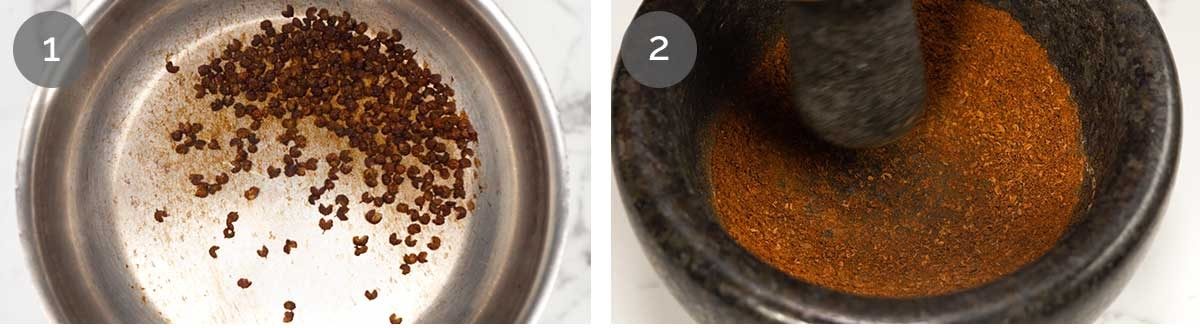
Toast the peppercorns in a small skillet (no oil) over medium heat for 2 – 3 minutes until they smell fragrant and some crack open. Take care not to burn them as they will become bitter.
Grind – Transfer into a mortar and pestle or spice grinder, then grind into as fine a powder as you can.
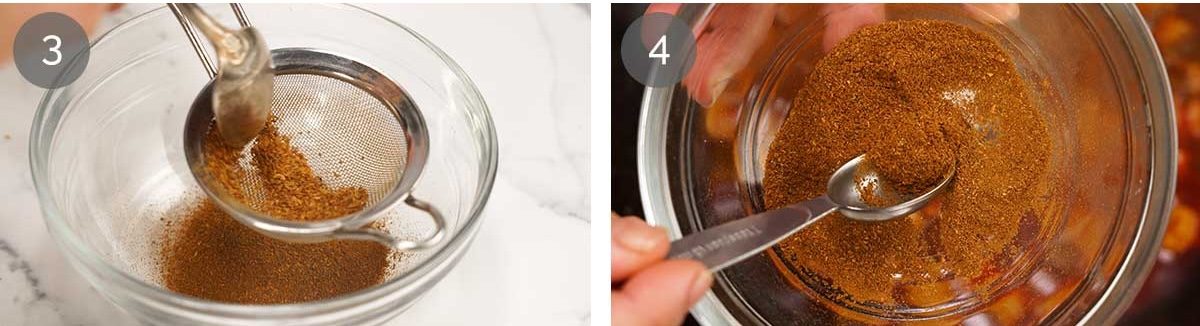
Sift the powder to remove larger bits of touch husk (discard them).
Measure out one teaspoon of powder. This gets added in two parts – half into the mapo tofu, and half sprinkled on the top just before serving.
2. BLANCH TOFU
The purpose of this step is to remove raw beany flavour from the tofu and season the inside. I was skeptical of the necessity of this step so I skipped it once…and regretted it. Chef Hannah knows best! ☺️
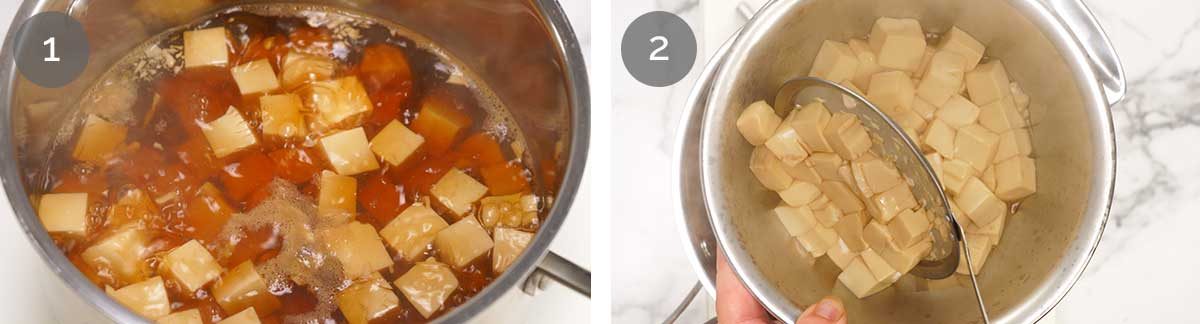
Simmer the tofu in water with salt and soy sauce for 3 minutes. Don’t worry, the tofu doesn’t fall apart! In fact, the opposite happens – I noticed that after blanching, the delicate silken tofu is a little less fragile.
Slotted spoon – Remove the tofu into a bowl using a slotting spoon, then set aside. (Don’t drain in a colander, you’ll get more tofu breakage).
3. MAKE THE MAPO TOFU!
Now that the groundwork has been done, the actual making of mapo tofu is just like making a stir fry, with the addition of a little simmer time. 🙂
If you don’t have a wok, use a medium pot rather than a fry pan or skillet. We don’t want to use something with a large surface area, otherwise the liquid will be too shallow for the tofu to properly braise and absorb flavour (OMG, bland tofu, nooo!!). Plus, the sauce will evaporate too quickly.
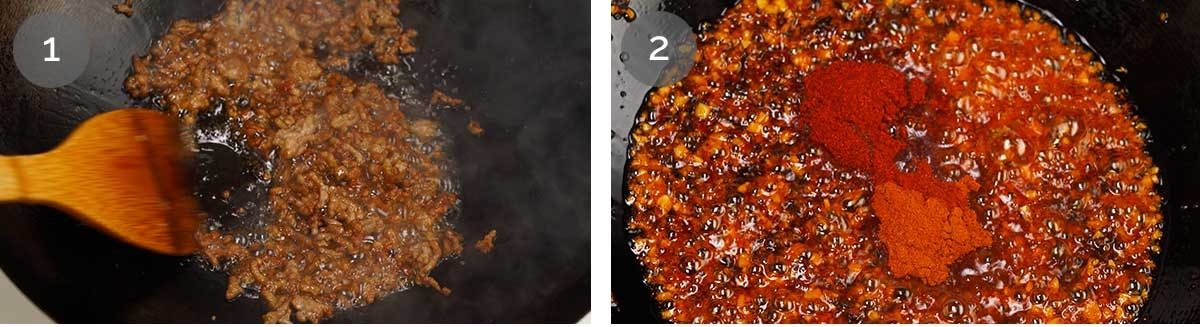
Golden pork – First, we cook the pork with a little soy sauce until it is golden. Then remove it into a bowl and set aside.
Sauté – Next, the aromatics get sautéed to create the flavour base for the sauce. Garlic and ginger first for 1 1/2 minutes, then the salted black beans and chilli bean paste for a good 3 minutes, then lastly the chilli powder and paprika goes in for 30 seconds.
All this happens on low heat so the garlic and ginger doesn’t burn! Having plenty of oil also helps here. 🙂
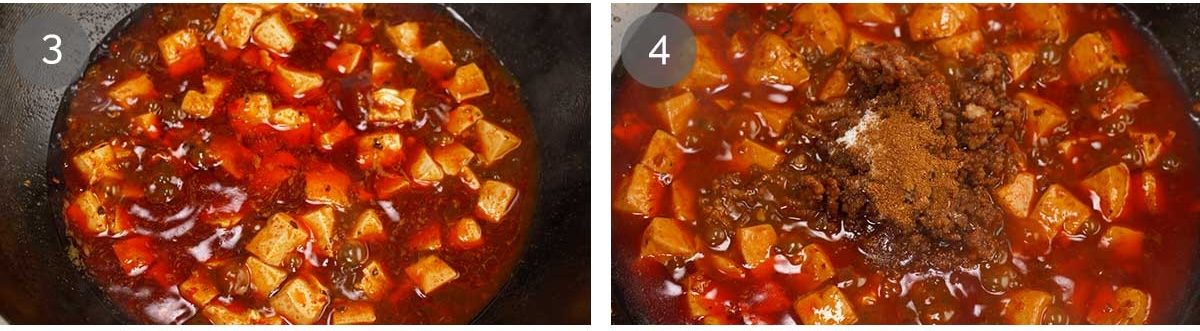
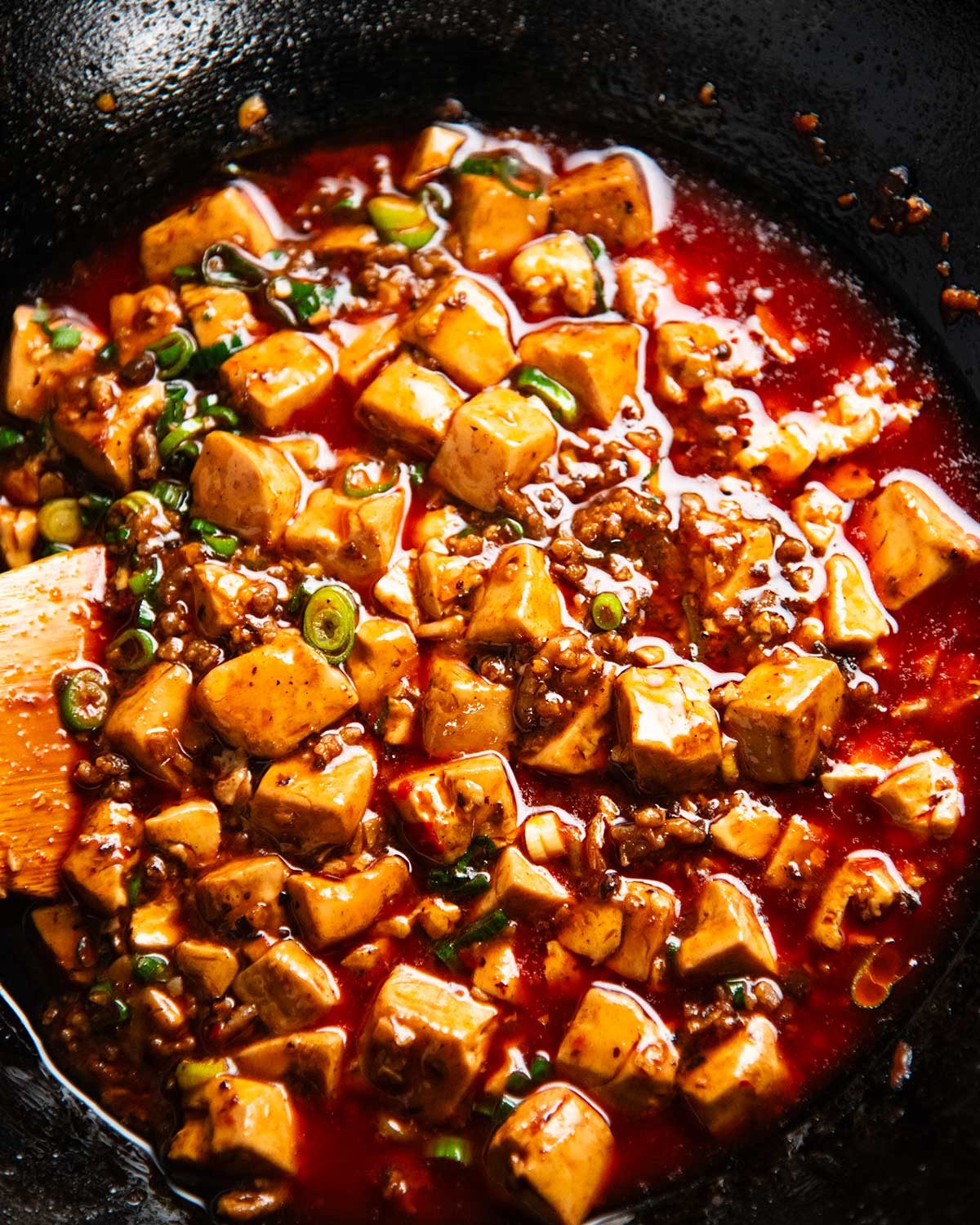
10 minute simmer – Add the beef stock, soy sauce and tofu, then simmer for 10 minutes. During this step, the liquid will reduce a bit (but there should still be plenty at the end of this step) and the tofu will absorb all the amazing flavours in the sauce.
Use a rubber spatula to gently scrape across the base of the wok gently every now and then to make sure nothing is sticking. Don’t stir aggressively, you’ll break the tofu! Also, adjust the heat as needed if it starts bubbling too hard, you want it at an average simmer with constant but not rapid bubbles.
Finish – Add the sugar, pork and 1/2 a teaspoon of the Sichuan pepper, and gently stir (I do all my tofu stirring with a rubber spatula, to minimise breakage).
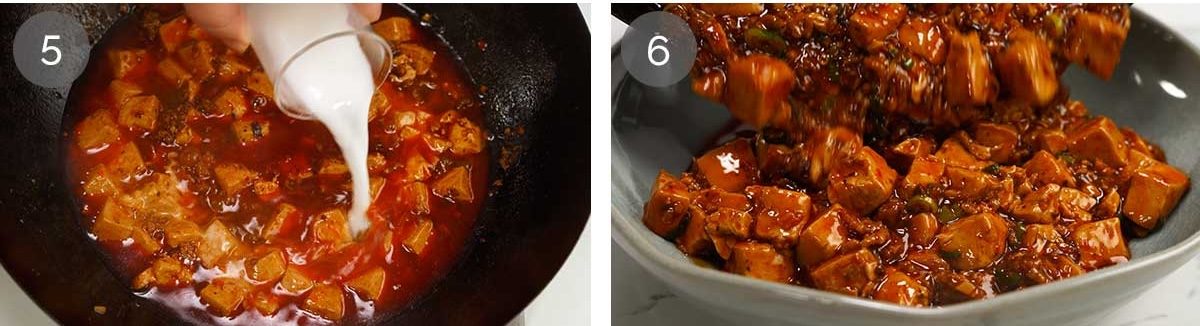
Thicken – Mix the cornflour and water together (this is a cornflour slurry) and pour that all over the surface, don’t dump in one place. Then gently stir and simmer for 2 minutes – the sauce will thicken and become shiny.
Finish – Stir in the green onion and sesame oil then pour rather than spoon into a serving dish (spooning = more tofu breakage). Sprinkle with the remaining 1/2 teaspoon of Sichuan pepper – don’t forget this, a fresh sprinkle really makes the flavours sing.
And finally, garnish with a little green onion if desired, and serve over rice!
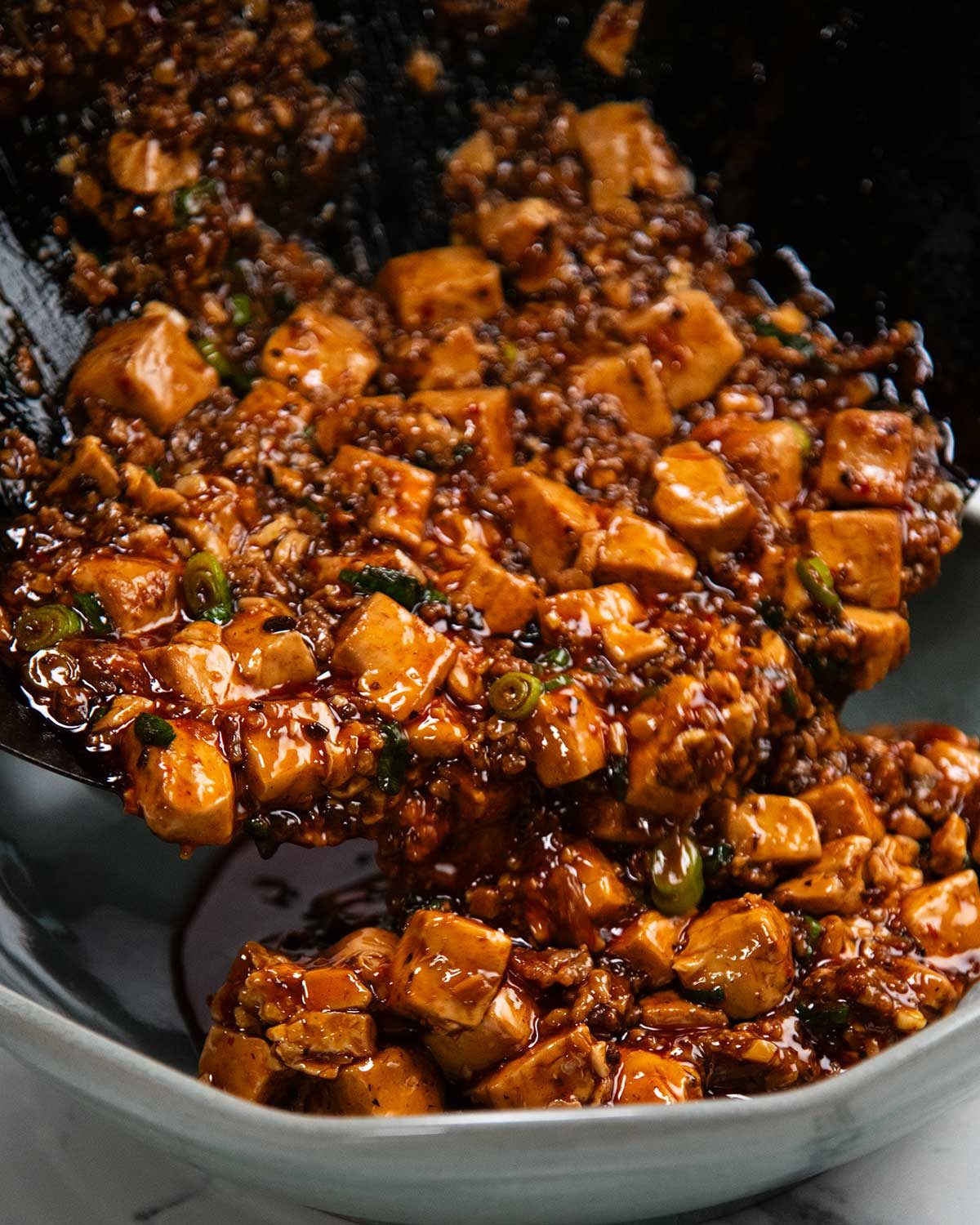
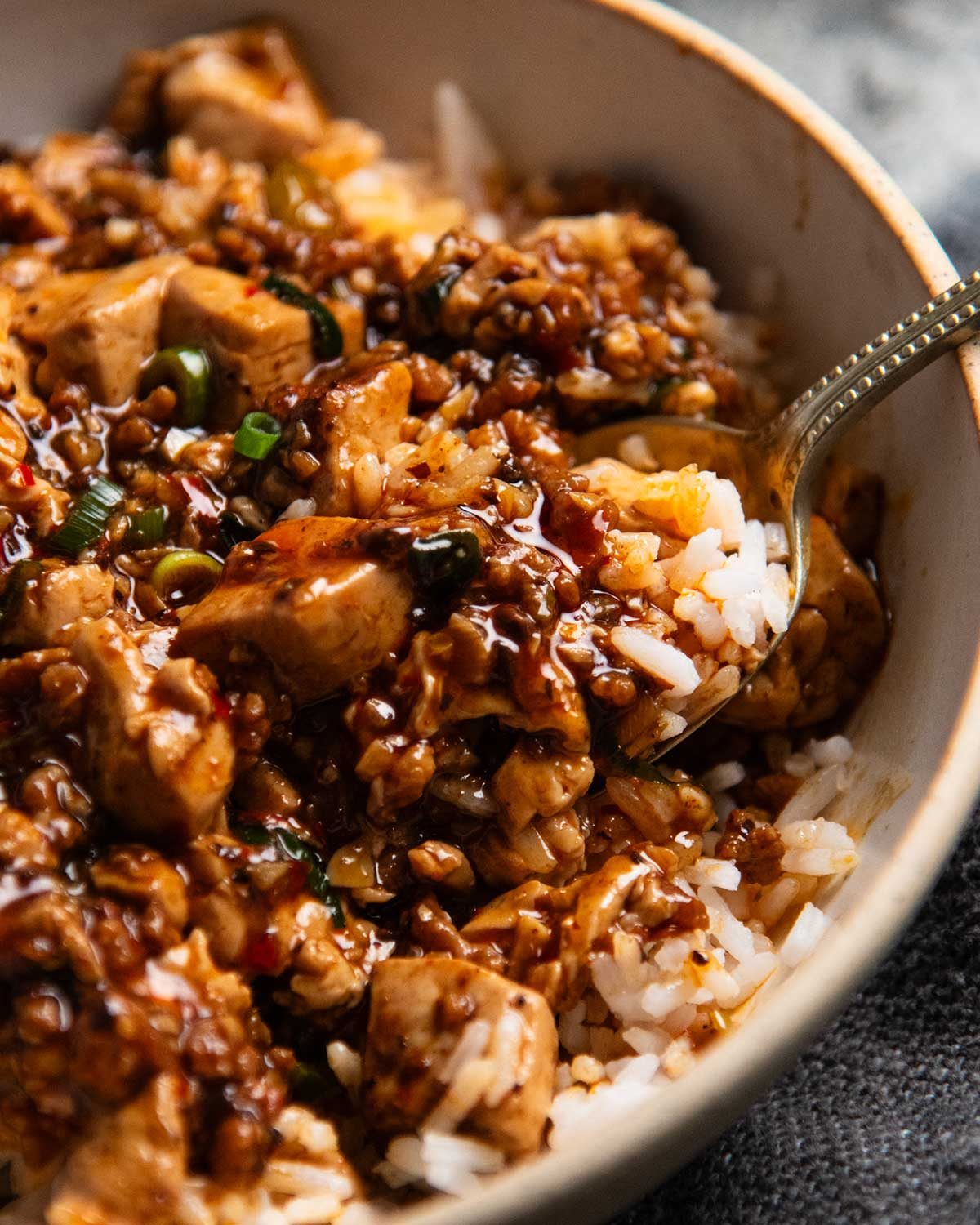
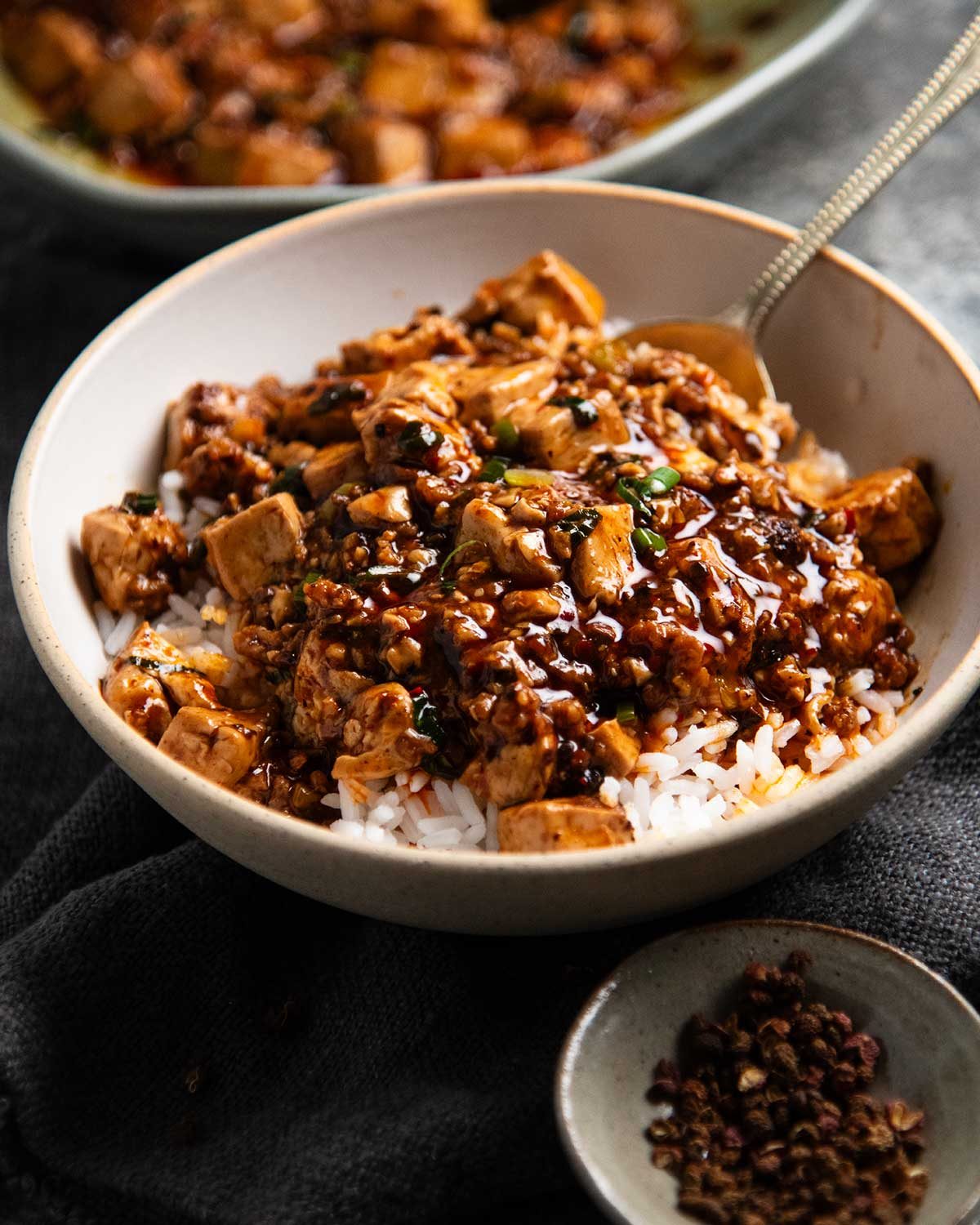
Serving over rice is essential, as it is quite a saucy dish. The way it soaks into the rice and coats every grain so you get mouthfuls of fluffy steamed rice smothered in that flavour-loaded sauce with the soft tofu that melts in your mouth and little golden nuggets of pork littered throughout….. UGH!! I am torturing myself just writing about it!!!
Well, good thing I have multiple tubs of it my fridge! Fair to say it took a few takes to shoot this, and between Hannah, JB and I developing and testing it, we probably made it close to 20 times. Iconic dishes like this always make me nervous leading up to posting day so there’s always a flurry of remakes to check final things – I think it’s 10 minutes simmer not 15, sauce reduces too much. What happens if people can’t find chilli powder and use cayenne instead, if they use the same amount it will blow their head off! Is pre-ground Sichuan pepper acceptable? Let’s try (ANSWER: No!).
I really hope you get a chance to give this a go. It truly is something really special. – Nagi x
Mapo Tofu FAQ
This is as authentic as we can make it outside of China, and the most important thing to know is that the flavour, spiciness, savouriness, texture, colour, how it looks – everything – has been given the nod of approval by our Sichuan-born Chef Hannah who created this recipe.
Here are the ways in which this recipe differs to the traditional way it is made in China:
Caiziyou oil – This is roasted rapeseed oil and it is the most common cooking oil in the Sichuan province. It has a distinct almost mustard-seed flavour, a flavour that Westerners are not familiar with because it’s not an oil used by Chinese restaurants in Western countries. Here in Australia, it is difficult and expensive to find. Chinese restaurants here commonly use canola, vegetable and peanut oil, all of which are very neutral in flavour.
So our recipe does not use caiziyou oil. If you have it, and want to make a strictly traditional one, by all means use it – and leave a comment telling us you did! You will make Hannah very proud. ☺️
Redness of oil – Authentic Mapo Tofu gets its vivid red oil from chilli powder alone. In China, chilli powder is available with varying levels of heat, so by using mild/medium chilli powders, you can get that vibrant red colour without making the dish insanely spicy.
But because the chilli powder sold here in Australia comes with just one level of spiciness, we use paprika to provide most of the colour, with chilli powder for heat. This gives us the right look without overwhelming spiciness.
Pork vs beef – The original Sichuan version is generally made with minced beef (ground beef). That said, pork is also extremely common in China today – in fact, Hannah tells me it is more common even in the Sichuan province – and is probably the version you’ll encounter most often outside Sichuan, and certainly in Australia.
We tried it with both and to be honest, I personally prefer pork because it has a softer texture that melds beautifully with the silken tofu. But it was still extremely delicious with beef, and if I didn’t have pork I would happily use beef instead!
Mapo Tofu is spicy but it is not “blow your head off” spicy like, say, Vindaloo. I can eat spoonfuls of it without rice and I’m not guzzling down ice water between bites!
The spiciness comes from chilli, not the Sichuan pepper which provides a numbing tingling sensation rather than being hot-spicy. See the recipe card for how to reduce and control the spiciness.
I haven’t tried this, but I think it’s totally doable and it will still be utterly delicious! I would use 200g/7oz of finely chopped mushrooms (just regular ones) instead of the pork, and vegetable stock rather than beef stock. Just follow the recipe as is. The sauce has so much flavour, I am confident it will be delicious!
This one is rather tricky, I’m afraid. Ordinarily I do my best to offer alternatives, but because Mapo Tofu has such a distinctive and iconic flavour profile that is reliant on a few key ingredients – broad bean sauce (doubanjiang), salted black beans and Sichuan peppercorns – I can’t suggest substitutions for these. They are Asian store staples and collectively cost around $10, and you don’t use very much for each batch so it will go a long way – if that helps convince you too make a trip to an Asian store! 🙂
3 to 4 days in the fridge, though I’d add a sprinkle of freshly ground Sichuan pepper to freshen it up. Not suitable for freezing.
This is a recipe that was developed by Chef Xiao (Hannah) Huang, one of our chefs at RecipeTin Meals (our food bank). Hannah was born and raised in Sichuan and comes from a long line of chefs – her dad’s a chef, her uncle, her grandfather!
Over a few months, we worked together to translate her family recipe into one that home cooks can make using ingredients that are readily available outside China, without compromising the authentic flavour. We tested countless batches, compared different ingredients (like similar bean sauces), and fine tuned every step to make it as foolproof as possible. For example, I burned my first batch of tofu! I didn’t realise the sauce would catch so easily on the base of the wok, and I was worried about breaking the tofu if I stirred it. So we reduced the stove strength, and added the instruction to “scrape” the base, rather than stir, with a rubber spatula to avoid breaking the tofu.
It was a labour of love – and after more than 20 years of searching for a Mapo Tofu that truly measured up to the unforgettable versions I ate in China, I honestly couldn’t be happier with where we landed. Hannah, we salute you. This Mapo Tofu is EPIC. The flavour punch is unbelievable, and it’s perfectly balanced. YOU ARE A LEGEND!!
Watch how to make it
Hungry for more? Subscribe to my newsletter and follow along on Facebook, Pinterest and Instagram for all of the latest updates.
Mapo Tofu
Ingredients
- 1 tbsp whole pink Sichuan peppercorns (or green) – for 1 tsp powder (Note 1)
Blanched tofu:
- 600g/ 21 oz silken tofu , cut into 1.5cm / 0.6″ squares (Note 2)
- 2 1/2 cups water
- 1 tsp cooking salt / kosher salt (halve for table salt, +50% for salt flakes)
- 1/2 tsp dark soy sauce (Note 3)
Golden pork:
- 1 tbsp canola oil , or other neutral oil eg. vegetable, peanut
- 100g/ 3.5 oz pork mince (ground pork), preferably 20% fat but even lean is fine, or beef (Note 4)
- 1 tsp light soy sauce (or regular / all-purpose soy, not dark soy sauce)
Mapo tofu:
- 1/4 cup canola oil (Note 5)
- 2 tbsp garlic , finely minced (4 large cloves)
- 2 1/2 tbsp ginger , finely minced with a knife
- 1 tbsp preserved black beans (aka salted black beans, fermented black beans), finely chopped (Note 6)
- 1 tbsp broad bean sauce/paste , we use Pixian doubanjiang, the spicy Sichuan version (Note 7)
- 1 tsp light soy sauce (or regular / all-purpose soy, not dark soy sauce)
- 2 tsp chilli powder , pure – NOT US chili powder blend (Note 8)
- 1 tsp smoked paprika (substitute regular/sweet paprika)
- 1 tsp white sugar
- 1 green onion stem , finely sliced
- 3/4 cup beef stock/broth , low sodium
- 1 tsp sesame oil (toasted ie. brown, not un-toasted which is yellow)
Cornflour slurry
- 2 tsp cornflour / cornstarch
- 1/4 cup water
Serving
Instructions
ABBREVIATED RECIPE:
- Toast, grind and sift Sichuan peppercorns. Blanch tofu 3 min. Cook pork until golden, remove.
- Sauté garlic and ginger 90 sec, then black bean and bean sauce 3 min, then chilli and paprika 30 sec. Add beef stock and soy, simmer tofu 10 min. Add sugar, pork, 1/2 tsp Sichuan pepper, then thicken sauce with cornflour slurry. Stir in green onion and sesame, serve garnished with 1/2 tsp Sichuan pepper.
FULL RECIPE:
Sichuan pepper powder:
- Toast peppercorns – In a small skillet over medium heat (no oil), toast the peppercorns for 2 – 3 minutes until fragrant (some will “pop” and crack open).
- Grind and sift – Transfer to a mortar and pestle, or spice grinder. Cool for a few minutes, then grind as finely as possible. Sift through a fine mesh sieve to remove the coarser husks (discard these). Measure out 1 teaspoon to use in the dish.
Blanched tofu:
- Blanch – Bring the water, dark soy and salt to a boil in a large saucepan over higher heat. Carefully add the tofu, then once it comes back up to the boil, lower the heat slightly so it’s simmering rapidly and simmer for 3 minutes. This step removes raw beany flavour and seasons the tofu. And don't worry, the tofu won't fall apart!
- Remove – Use a slotted spoon to carefully scoop the tofu out into a bowl. Set aside.
Mapo tofu:
- Cook golden pork – Heat the oil in a wok over high heat. (Note 9) Cook pork, breaking it up as you go, until you no longer see pink. Then lower the heat to medium and cook for another 2 minutes until the pork has golden bits. Add the light soy sauce, stir for 5 seconds, the remove the pork into a bowl and set aside.
- Sauté aromatics – Reduce heat to low. Add the rest of the oil into the wok, then cook the garlic and ginger for 90 seconds. Add black beans and broad bean paste, cook for 3 minutes, stirring constantly. Add chilli powder and paprika, cook for 30 seconds..
- Simmer – Add the beef stock and light soy. Turn the heat up to medium high, then once it starts bubbling, gently add the tofu (discard any excess water pooled in the tofu bowl). Simmer gently for 10 minutes (lower heat as needed), gently scraping the base with a rubber spatula every now and then to ensure it doesn’t catch (I push across base, avoid stirring as tofu will break). There should still be plenty of liquid at the end, mapo tofu is saucy.
- Cornflour slurry – Mix the water and cornflour together. This will thicken the sauce.
- Thicken sauce – Add the sugar, pork mince, 1/2 teaspoon sichuan powder. Stir gently using the rubber spatula. Pour the cornflour slurry all over the surface (not in one place) then gently stir again.
- Finish and serve – Stir in most of the green onion (reserve a little for garnish) and sesame oil. Pour into a serving bowl. Sprinkle with remaining Sichuan pepper and garnish with green onion. Serve over rice!
Recipe Notes:
1. Sichuan peppercorns provides the signature tongue-tingling numbing effect that mapo tofu is famous for! It is not fiery spicy, like chilli. Chef Hannah insists grinding your own is essential for mapo tofu because the flavour is immeasurably better. She even made this using pre-ground at my request, and her verdict was clear – the flavour just wasn’t there. 2. Silken tofu is the really soft, wobbly jelly-like type of tofu. Drain off water before use, and handle with care because it’s fragile! Expect some breakage during cooking, it’s inevitable, and some little bits of broken tofu are a characteristic of mapo tofu. 3. Dark soy has a more intense flavour and colour than regular soy, and it stains the tofu a light brown colour which is characteristic of authentic mapo tofu. It would not be the end of the world to use light soy or a regular all-purpose soy. 🙂 4. Meat – Beef is actually the traditional meat used so it can be used too. But pork is widely used these days and I think it’s the meat that most Westerners associate with Mapo Tofu. I like that it is softer than beef so it melds better with the tofu. I’ve never seen beef in Mapo Tofu here in Sydney. 5. Oil quantity – Authentic mapo tofu has a layer of red oil on the surface, so you need this much to make the real deal! However, you could reduce if desired, but shhh don’t tell Hannah! 6. Salted black beans (preserved black beans) – They are actually soy beans! This is a key ingredient for flavour in mapo tofu, so I can’t offer a substitute. Also called fermented black beans and used in Beef in Black Bean Sauce, find it in Asian stores in the pickled/vac packed vegetable aisle, ~$2.70 a pack (long shelf life, or freeze). Wrinkled and a little squishy like raisins, not rock hard, and they are not black beans as in the legume. 7. Chinese broad bean sauce (doubanjiang) is a fermented paste made from broad beans, soybeans, and salt, often with chilli. It’s savoury, salty, and packed with umami. Also used in Spicy Sichuan Eggplant and Minced Pork! We use the spicy Sichuan version (Pixian doubanjiang) which is a well known brand. 8. Chilli powder – Not to be confused with US chill powder (one “l”) which is a Tex-mex spice blend that is not spicy, this is what brings hot spiciness to the dish (reminder: mapo tofu is spicy!). Makes it spicy but not blow-your-head-off. If you’re worried, start with less and stir in more at the end after tasting. Cayenne pepper substitute – works perfectly but use half. 9. Cooking vessel – If you don’t have a wok, use a medium pot rather than a skillet/fry-pan as else the surface area will be too large and the liquids will evaporate too quickly, plus you’ll find it harder to stir gently without the tofu breaking a lot. Leftovers – This is a dish best enjoyed freshly made, though leftovers will keep for 3 to 4 days in the fridge, though I’d add a sprinkle of freshly ground Sichuan pepper to freshen it up. Not suitable for freezing. Nutrition per serving, assuming 5 servings. Excludes rice. (I’m secretly thrilled it’s so low because you know that means I can enjoy MORE guilt-free!!)
Nutrition Information:
Life of Jaffle
Sometimes, exceptions simply have to be made to the “no dogs on couch” rule……. 🥹

…especially when I caught Jaffle kissing Dozer’s face. Stay there all day if you want, Jaffle! Never mind your muddy belly! 🥰

The Dozer cushion was an incredibly thoughtful gift from a reader. The generosity and kindness of this community never ceases to amaze me.
There was also one with my face on it. My mother sits on it when she’s cranky with me. 😆 💨

Love the pic of Jaffle kissing Dozer!!!!
You are truly blessed with beautiful Jaffle.💕 He is so lovely!!!
That photo melts me every time 🥹 Thank you Mel!! – N x
Love the pic of Jaffle kissing Dozer!!!!
You are truly blessed with beautiful Jaffle.💕
Wow! Mapo Tofu is my favorite Chinese dish. At our local Chinese restaurant they call it “Spicy Meat Sauce with Tofu”. They use ground pork in their version. I am not sure it is as hot as your recipe though ha ha. I will have to try your version though it sounds wonderful.
Thank you chef Hannah, Chinese food is one of my favorite ❤️
Hope you get a chance to try this Cheryl! – N x
I’m not understanding what the chili powder is if it’s not American chili powder. What kind of chili powder can it be please.
Hi, in The US chili powder is a blend of seasoning spices which doesn’t include any heat; in Australia (and here in NZ) chilli powder is literally dried, powdered chilli peppers, and it’s hot! Hope that helps (yes I found out the hard way lol🥵
Thanks for helping out Amity!! You’re right on 🙂 – N x
You could try cayenne powder. It is quite hot. There are other powdered hot chili peppers out there like Ancho and Chipotle. Each has varying levels of heat and flavor. Hope this helps.
Nagi, I can’t even………Once again, I go right to Jaffle section. And my heart melted all over again. Like you, I still miss sweet Dozer so very much. And like you, I am totally in love with Jaffle and I am so happy you went with your heart and added him to the family. I have a feeling that Dozer is happy about that because he knows how much we all loved reading about him and his adventures with you. And he knows how much we all miss him too. And, I’m pretty sure him and Jaffle are communicating during that sweet pillow kiss. Thank you so much for sharing this all with us Nagi! And maybe someday, I will go to the recipe before I go to the puppy section, maybe……… Hugs to all of you!
Haha I don’t think I’m ever going to win the battle against the puppy section! 😂 Thank you Kathy, and I love that little pillow photo too. It gets me every time – N x
Hi Nagi and Jaffle
and the lovely Dozer in doggie heaven
I will make this (minus the pork) however as I live outside a city will have to visit my favourite Asian supermarket for some of the ingredients
love xx
Hope you enjoy your Asian supermarket visit! 😂 It’ll be worth it, I promise. Sending love right back! – N x
Most delicious! The best!!! A dream!! Can’t get enough. Oh, about the Mapo Tofu recipe, that looks delicious too. 🙂
Big hugs from Kentucky!
Hahaha!! 😂 I had a feeling Jaffle might steal the show this week. Big hugs back to Kentucky! – N x
I’d like to try and make this dish. My partner can’t handle too much chilli or spice. So on a scale of 1 – 10 how spicy would this dish be please.
8
Wow!! Thank you for your reply. Have to pass on that one.
Hi Andrew! Reducing and controlling the spiciness is easy, I popped the directions in the recipe notes 🙂 Hope it helps! – N x
Never had Mapo Tofu but that is about to change as this looks and reads as YUM!!!
The world needs more of Jaffle kissing Dozer🐾
Can’t wait to try. Made this once but I bet yours is better. One note, I wouldn’t use canola oil. It’s a seed oil and something we all need to eliminate as much as possible (I’d say with the exception of a little sesame oil here and there). I use olive oil (real – many are fake) in all my recipes (including cake that calls for veg oil) and it’s never done me wrong! 🙂
Oh, how wonderful, now, after reading the comments, I feel like a complete moron. I have never even heard of Mabo Tofu, so I went straight to the Jaffle section. He looks happy. As for your mom sitting on your pillow once in a while, I do understand because if I had a pillow with my husband’s face printed on it, oh goodness, as much as I love him, the pillow would get some abuse (regularly).
oi, sou do brasil. Trabalhei em uma agencia de publicidade muito criativa, vencedora de varios premios internacionais, nos anos 90. Era em são paulo, e no ultimo andar tinhamos uma cobertura aberta com muito verde, mesa de snooker, churrasqueira, bar e num canto, um saco de areia usado no boxe, estampada com a cara de nizan guanaes, fundador da agencia. qdo estavamos bravo com ele, podia subir o socar a cara com vontade kkkkkkkkk
Mapo Tofu is one of our favourite dishes and makes a regular appearance on our dinner table. Coincidentally, it was on the menu again this evening when my partner noticed your post! A small pivot from our usual recipe to yours and we were delighted with the change. So delicious, with a really nice level of heat. And a such a simple dish to make! Thank you for another sensational recipe 🙂
I remember Mabo Tofu from my two years living in Japan but for some reason, I remember the tofu being firm. I’m probably wrong but do you think it’s a substitution for silken tofu? Finally, I was in Adelaide for a few days and picked up several items at an Asian food store – pretty much exactly the ones you show in the video! (We live 300km away in a small rural town where specialty items are simply not available…. even silken tofu!)
I’ll be making this very soon! Oh, hi Jaffle!
❤️❤️❤️❤️❤️❤️ wonderful pics and great recipe. I can’t wait to try, as always. Wishing you lots of love and fun with Jaffle.
Hi Nagi and Hannah, not made it yet but it looks amazing! Would it be as tasty if I leave the meat out to make it vegetarian?
Mushrooms are often a good sub for meat. But which mushrooms and how to prepare them, Between Nagi and Hannah there must be an answer.
Looks amazing 😁can we just leave out the pork and sub vege stock?
Oh my GAAAWWWDDD…
Truly a heavenly experience.
Thank you Chef Xiao (Hannah) and Nagi, thank you 🫶🏽
Nagi – you have been perfecting this recipe for twenty years – well, this is about as long as the time I first fell in love with it on an Asian cookery show and tried and loved > AND it was nowhere as detailed a recipe as what you have shown. No problem to make it in Australia . . . cannot wait to see what Chef Hannah’s family Mapo Dofu recipe creates – exciting with my love of Sichuan cooking 🙂 ! Jaffle – methinks he not only is a star pupil but in his tiny heart and mind knows that that dog in the pictures and cushion is part of the family . . . enjoy the weekend and barrack for our boys in Dallas tomorrow morning 🙂 !
This is a weekly dish for me at this time of year, and a keto/low-carb winner with cauli rice. Your recipe is pretty close to how I’ve done it in the past – I use some five spice late, and sometimes a touch of ground cumin if I use lamb mince (which is an underrated choice). Also a drizzle of untraditional shaoxing.
The sichuan peppercorn point is one I want to take up. I agree with you that whole corns are better, but I have found plenty of the brands available here in Aus can get sandy. I’ve tried both spice grinder and mortar and pestle, and I have the same problem more often than not. As a result, I usually resort to ground, despite it being far less… well, numbing, which is kinda the point. Have looked at importing from Mala Market stateside before, but shipping is astronomical. Have you had this same issue, and do you have any trick to it?